

Alexander finn Site

Need help? Text us, and a team member will reply in mins +1 123 456 7891

Have questions about bpc-157?
Text us: +1 123456789

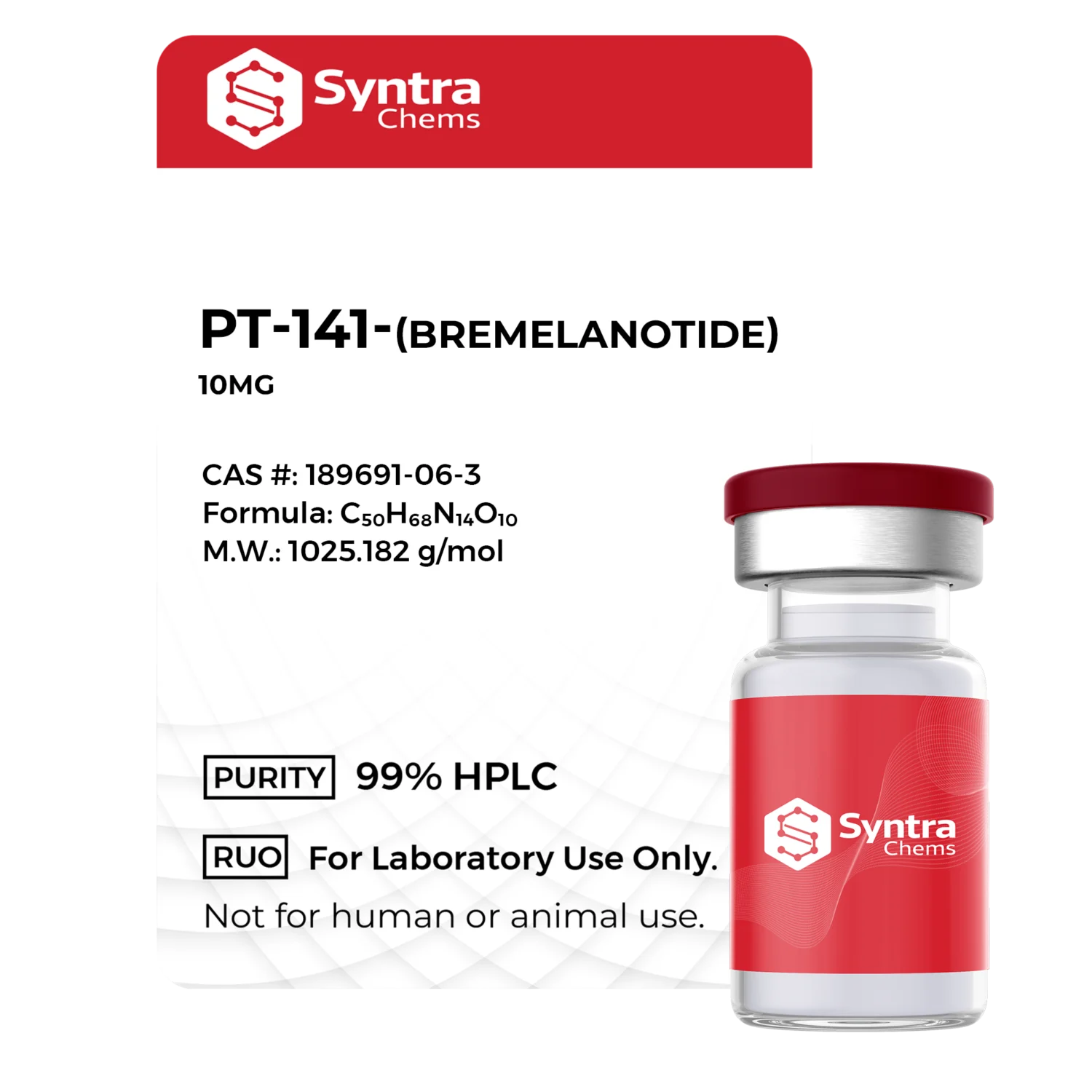
PT-141

Compounded Melanocortin

Price range: $49.00 through $439.00

Quantity

Research Use Only

These products are for laboratory research only and not intended for medical use. They are not FDA-approved to diagnose, treat, cure, or prevent any disease. By purchasing, you certify they will be used solely for research and not for human or animal consumption.

What is PT-141?

PT-141, also known as Bremelanotide, is a synthetic peptide classified as a melanocortin receptor agonist. In laboratory research, it is studied for its activity within the central nervous system and its interactions with melanocortin pathways.

Made in the USA

Quality controlled from start to finish.
No outsourcing.

Need Help?

Send us a message.

PT-141 Overview

PT-141, also known as Bremelanotide, is a synthetic peptide analog of α-melanocyte-stimulating hormone (α-MSH). It is studied in laboratory and preclinical models for its ability to activate melanocortin receptors (MC3R and MC4R), which are involved in neuroendocrine signaling, energy regulation, and vascular pathways.

Dorr R.T. et al. (1996).

History

PT-141 was developed through research into melanocortin peptides, originally derived from modifications of Melanotan II. While Melanotan II was primarily studied for its pigment-inducing properties, PT-141 was synthesized to focus on central melanocortin receptor activity. Since its discovery, PT-141 has been investigated in models of neuroendocrine function, vascular regulation, and receptor-mediated signaling.

Shadiack A.M. et al. (2002).

PT-141 Structure

CAS #: 189691-06-3

Molecular Formula: C₅₀H₆₈N₁₄O₁₀

Molecular Weight: 1025.2 g/mol

PubChem ID: 6918280

Research Findings

PT-141 has been studied in neurological, endocrine, and systemic models, with research highlighting its activity in melanocortin receptor pathways, neuroendocrine signaling, and systemic regulation. Studies also report effects on central nervous system activity, hormone modulation, and vascular responses in preclinical settings.

Key Areas of Research:

• Neurological: CNS activity, receptor signaling, pathways

• Endocrine: hormone modulation, signaling balance

• Systemic: vascular responses, recovery, resilience

Together, these findings suggest experimental potential for PT-141 across neurological, endocrine, and systemic pathways. By engaging melanocortin receptors and influencing neuroendocrine activity, PT-141 provides a versatile platform for research into signaling biology, systemic balance, and central regulation in laboratory models.

Shadiack A.M. et al., 2004

Description

PT-141 Overview

PT-141, also known as Bremelanotide, is a synthetic peptide analog of α-melanocyte-stimulating hormone (α-MSH). It is studied in laboratory and preclinical models for its ability to activate melanocortin receptors (MC3R and MC4R), which are involved in neuroendocrine signaling, energy regulation, and vascular pathways.

Dorr R.T. et al. (1996).

History

PT-141 was developed through research into melanocortin peptides, originally derived from modifications of Melanotan II. While Melanotan II was primarily studied for its pigment-inducing properties, PT-141 was synthesized to focus on central melanocortin receptor activity. Since its discovery, PT-141 has been investigated in models of neuroendocrine function, vascular regulation, and receptor-mediated signaling.

Shadiack A.M. et al. (2002).

PT-141 Structure

CAS #: 189691-06-3

Molecular Formula: C₅₀H₆₈N₁₄O₁₀

Molecular Weight: 1025.2 g/mol

PubChem ID: 6918280

Research Findings

PT-141 has been studied in neurological, endocrine, and systemic models, with research highlighting its activity in melanocortin receptor pathways, neuroendocrine signaling, and systemic regulation. Studies also report effects on central nervous system activity, hormone modulation, and vascular responses in preclinical settings.

Key Areas of Research:

• Neurological: CNS activity, receptor signaling, pathways

• Endocrine: hormone modulation, signaling balance

• Systemic: vascular responses, recovery, resilience

Together, these findings suggest experimental potential for PT-141 across neurological, endocrine, and systemic pathways. By engaging melanocortin receptors and influencing neuroendocrine activity, PT-141 provides a versatile platform for research into signaling biology, systemic balance, and central regulation in laboratory models.

Shadiack A.M. et al., 2004

Additional information

Pcs

Pack of 10, Single Vial

Strength

10mg

Reviews

There are no reviews yet.

Be the first to review “PT-141”

Your email address will not be published. Required fields are marked *

Text us, our dedicated team is here to help.

Reach out and get a response within minutes

+1 123456789