

Alexander finn Site

Need help? Text us, and a team member will reply in mins +1 123 456 7891

Have questions about bpc-157?
Text us: +1 123456789

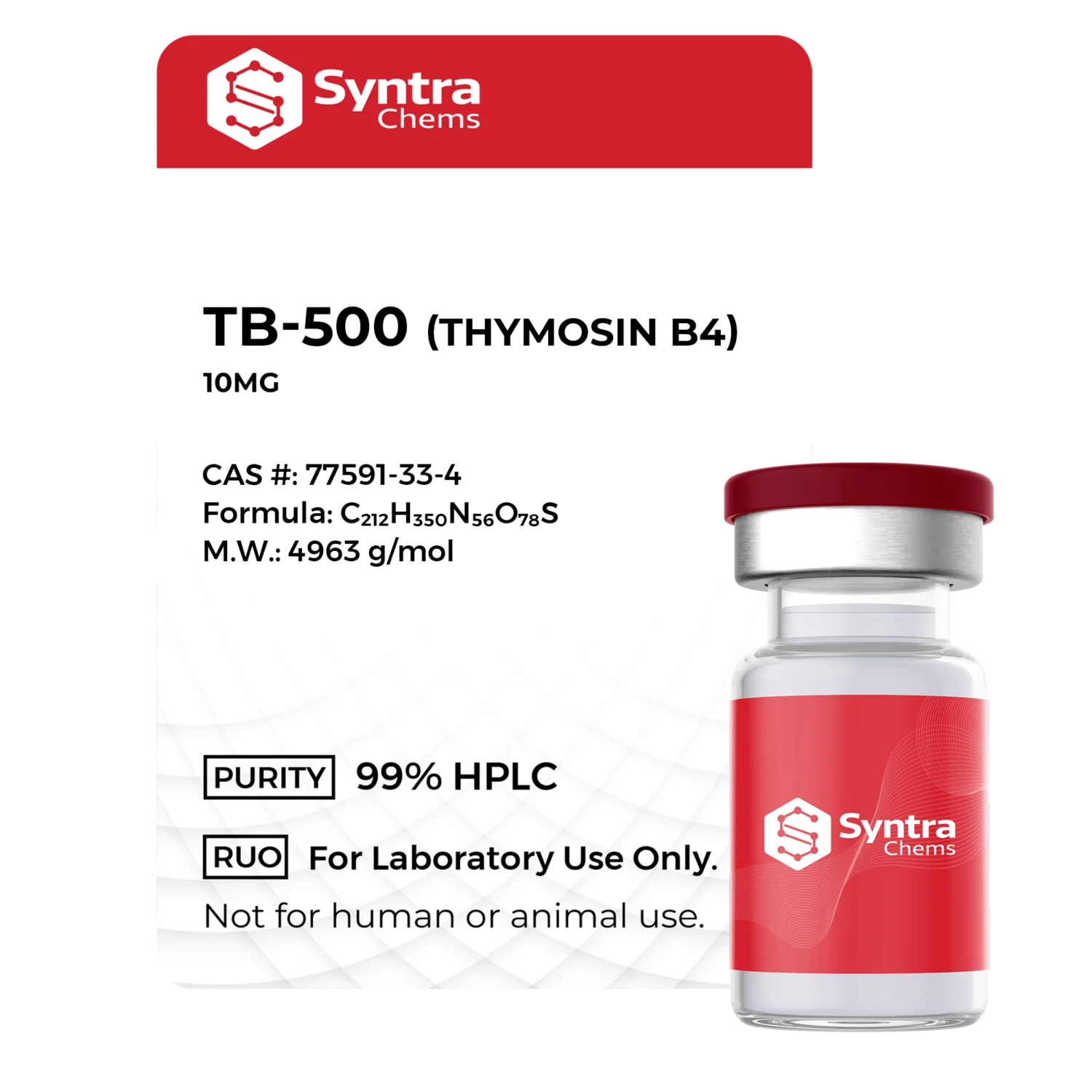
TB-500

Recovery Compound

Price range: $69.00 through $619.00

Quantity

Research Use Only

These products are for laboratory research only and not intended for medical use. They are not FDA-approved to diagnose, treat, cure, or prevent any disease. By purchasing, you certify they will be used solely for research and not for human or animal consumption.

What is TB-500?

TB-500 is a lab-synthesized peptide derived from a sequence of Thymosin Beta-4. Researchers frequently examine it in controlled studies for its potential involvement in wound models, angiogenic processes, and cellular structural pathways.

Made in the USA

Quality controlled from start to finish.
No outsourcing.

Need Help?

Send us a message.

TB-500 Overview

TB-500 is a synthetic peptide fragment derived from thymosin beta-4, a naturally occurring protein studied for its role in cellular repair and regeneration. Research has focused on its potential influence on tissue remodeling, angiogenesis, and cellular migration in preclinical and laboratory models. TB-500 is of particular interest in investigations involving connective tissue, muscle recovery, and wound repair pathways.

Goldstein A.L. et al. (2005). 

History

Thymosin beta-4 (TB4), the parent protein of TB-500, was first isolated in the 1960s during studies of thymus-derived peptides and their role in immune and regenerative biology. TB-500 was synthesized as a research analog to enable focused study on TB4’s tissue repair functions. Since its development, it has been investigated across models of angiogenesis, muscle regeneration, and cellular migration, with growing interest in its systemic regulatory potential.

Goldstein A.L., Hannappel E. et al. (2012).

TB-500 Structure

CAS #: 885340-08-9

Molecular Formula: C₂₁₂H₃₅₀N₅₆O₇₈S

Molecular Weight: 4963.5 g/mol

PubChem ID: 16132321

Research Findings

TB-500 has been studied in structural, vascular, dermatological, and systemic models, with research exploring its roles in collagen organization, extracellular matrix remodeling, angiogenesis, wound closure, and tissue recovery in preclinical settings.

Key Areas of Research:

• Structural: collagen, matrix, tendon/ligament

• Vascular: angiogenesis, nitric oxide, remodeling

• Dermatological: wound closure, inflammation, epithelium

• Systemic: protection, viability, recovery

Together, these findings suggest broad experimental utility for TB-500 across multiple biological pathways. By engaging structural and vascular processes and supporting epithelial and systemic responses, TB-500 provides a versatile platform for investigating tissue repair, recovery, and resilience in laboratory models.

Hsieh M.-J. et al., 2017

Description

TB-500 Overview

TB-500 is a synthetic peptide fragment derived from thymosin beta-4, a naturally occurring protein studied for its role in cellular repair and regeneration. Research has focused on its potential influence on tissue remodeling, angiogenesis, and cellular migration in preclinical and laboratory models. TB-500 is of particular interest in investigations involving connective tissue, muscle recovery, and wound repair pathways.

Goldstein A.L. et al. (2005). 

History

Thymosin beta-4 (TB4), the parent protein of TB-500, was first isolated in the 1960s during studies of thymus-derived peptides and their role in immune and regenerative biology. TB-500 was synthesized as a research analog to enable focused study on TB4’s tissue repair functions. Since its development, it has been investigated across models of angiogenesis, muscle regeneration, and cellular migration, with growing interest in its systemic regulatory potential.

Goldstein A.L., Hannappel E. et al. (2012).

TB-500 Structure

CAS #: 885340-08-9

Molecular Formula: C₂₁₂H₃₅₀N₅₆O₇₈S

Molecular Weight: 4963.5 g/mol

PubChem ID: 16132321

Research Findings

TB-500 has been studied in structural, vascular, dermatological, and systemic models, with research exploring its roles in collagen organization, extracellular matrix remodeling, angiogenesis, wound closure, and tissue recovery in preclinical settings.

Key Areas of Research:

• Structural: collagen, matrix, tendon/ligament

• Vascular: angiogenesis, nitric oxide, remodeling

• Dermatological: wound closure, inflammation, epithelium

• Systemic: protection, viability, recovery

Together, these findings suggest broad experimental utility for TB-500 across multiple biological pathways. By engaging structural and vascular processes and supporting epithelial and systemic responses, TB-500 provides a versatile platform for investigating tissue repair, recovery, and resilience in laboratory models.

Hsieh M.-J. et al., 2017

Additional information

Pcs

Pack of 10, Single Vial

Strength

10mg, 5mg

Reviews

There are no reviews yet.

Be the first to review “TB-500”

Your email address will not be published. Required fields are marked *

Text us, our dedicated team is here to help.

Reach out and get a response within minutes

+1 123456789